Hypervolition Study
Theory Development, Research-Creation, Realist Reviews, Experiments
Algorithms, Autonomy, and Art
Masters and Doctoral Research
MASTERS & DOCTORAL
Research Overview
Masters
MFA
2019 - 2021
Hypervolition: Our Sacrifice of Choice (OCADU)
This research critically examined power, governance, desire, and choice. In June 2020, Jevi coined the term hypervolition and defined the Orders of Desire, and Phases of the Choice Environment. These ideas on algorithmic influence are shared through a series of works, experiences, and texts that investigated and communicated the effects of our reliance on algorithms.

Doctorate
PhD
2021 - 2023
Continued Research
Completed two years of research within a Theory and Criticism (Philosophy) PhD program at Western University, and at a York University research lab. The works, Gaze\\corridor (2022), EVO (2023) were developed, as well as related theoretical writings. Voluntarily left the programme after two years to return to work, with the plan to later complete the study at a later date.
Doctorate
DBA
2025 - 2028
Hypervolition: Imposed Desires (ENU)
Building on the previous MFA and PhD work, this realist research exemplified the four Successive Phases of the Choice Environment (Jevinian Phases) and creates a classification framework for empirical study, Classes of Consumer Volition and Desire. It studies the prediction, influence, and manipulation of consumer decision-making and consumer desire, and aims to understand how marketing strategies classified within these categories work, why, and under what circumstances.

Masters & DoctorAL
Research Outcomes
Masters & Doctoral
Outcomes Summary
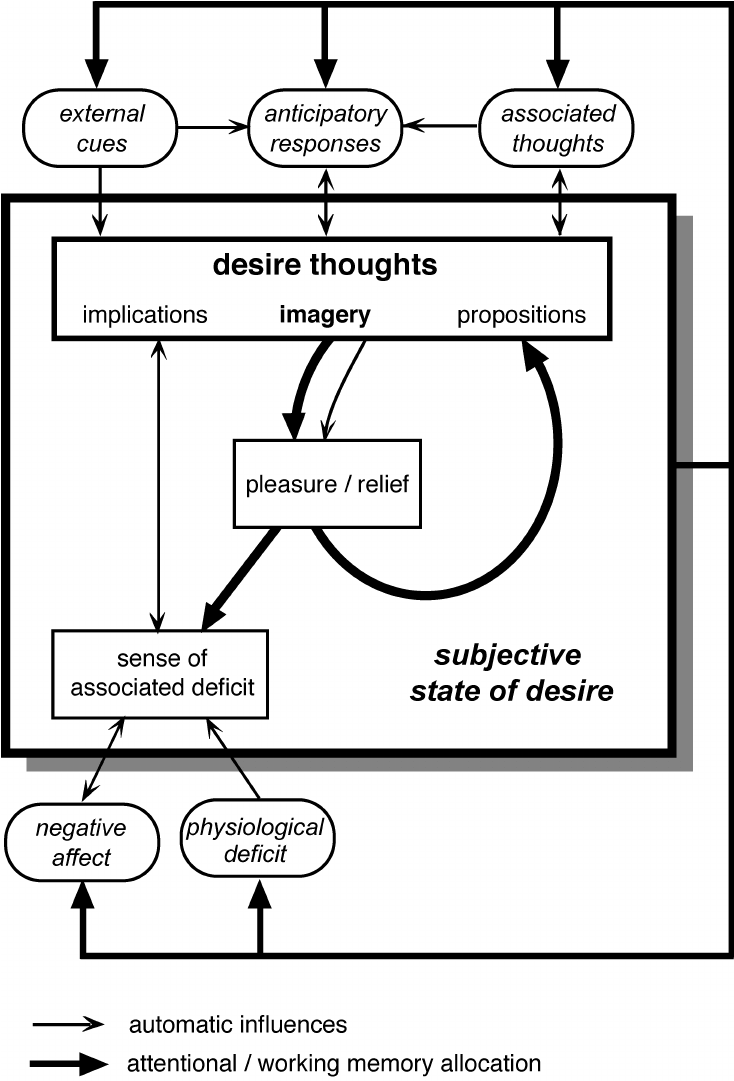
Jevi coined the term, hypervolition as “the inability of consciousness to distinguish our true desires and choices, from our algorithmically-deduced and imposed desires and choices”.
Jevi proposed that the evolution of volition is determined by mutations of the subject’s desired ideal within societies. She proposed the Orders of Desire, and the Successive Phases of the Choice Environment, and the Classes of Consumer Volition and Desire.
The Classes provide a comprehensive framework for understanding of how different marketing strategies and techniques influence consumer decision-marking at various stages of the decision process.
A realist research method at the doctoral level of this research, aims to uncover why, and under what circumstances these strategies work.
This research adheres to Transparency and Openness Promotion Guidelines (TOP), a policy framework for advancing open science practices.
DBA
Outcomes (Doctorate)
- Create a theoretically grounded classification framework that groups marketing strategies by their effect on consumer choice and desire. (Jevinian Classes)
- Develop clarification of the underlying boundary conditions via Context-Mechanism-Outcome (CMO) configurations, pinpointing when, how, and why predictive influence strategies become manipulative.
- Actionable governance insights, corporate audit guides, and immersive research-creation outputs to demystify algorithmic manipulation for the public.
DBA
Supervisors (Doctorate)
- Dr. Max Chipulu (Primary)
Associate Dean Research and Innovation, AI Expert & Mechanical Engineer - Dr. Jamie Thompson (Secondary)
Research Lead for the Marketing Group, Marketing Expert
MFA
Outcomes (Masters)
- Through critical theory, it coined the social theory term hypervolition, the ‘Orders of Desire’ and the ‘Successive Phases of the Choice Environment’. (Jevinan Orders & Phases)
- Conducted an art-based critical study of the relationship between algorithms, autonomy, and how it affects our choices and desires.
- Used art to communicate the findings into creative forms.
MFA
Supervisors (Masters)
- Dr. Julian Haladyn (Primary)
Cultural Theorist, Artist, Art Historian. - Dr. Ashok Mathur (Secondary)
Dean Graduate Studies, VP Research & Innovation. - Dr. Alexis Morris (Internal)
Canada Research Chair (Tier II) Internet of Things.
Masters & DoctoraL
Research Theory Outputs
MFA Social Theory Outputs (2019-2021)
Orders of Desire
Jevi proposed that the evolution of volition is determined by mutations of the subject’s desired ideal within societies. She proposed the following Orders of Desire.
- Disciplinary desire is a socio-normalising force within societies, which encourages conformity to the social norm. It utilises a desire to comply and cooperate to become the ideal member of society;
- Neuronal desire is a self-idealising force within societies, which encourages self-actualisation to the idealised sense of self – a self that is always not already “mine.” It utilises a desire to achieve, a trait of the “achievement subject;”
- Algorithm desire is a computation-assimilating force within the societies which encourages assimilation to an algorithmically deduced and provided idealised self.
MFA Social Theory Outputs (2019-2021)
Phases of the Choice Environment
Jevi proposed these Four Successive Phases of the Choice Environment:
- it is a reflection of the individual’s volition, and operates according to that will;
- it masks and perverts the individual’s volition, promoting another goal;
- it masks the absence of the individual’s volition, changing the available options, or impact of the individual’s interaction;
- it bears no relation to any volition: it is its own pure, self contained cybernetic intelligent system; the demarcation between a what would have been the individual’s volition and the algorithm implodes. This is hypervolition
MFA Social Theory Outputs (2019-2021)
Hypervolition
Jevi coined the term hypervolition and defined it as “the inability of consciousness to distinguish our true desires and choices, from our algorithmically-deduced and imposed desires and choices“.
MFA Critical Theory Outputs (2019-2021)
Critiques of Power, Governance, Aesthetics, and Discipline
DBA Critical Theory Outputs (2019-2028)
Critiques of Control
DBA Consumer Theory Outputs (2025-2028)
Classes of Consumer Volition and Desire
Jevi proposed the four Classes of Consumer Volition and Desire that describe how a consumer’s volition can be affected by marketing strategies.
DoctorAL
Realist Research Outputs
DBA
Rapid Realist Review 1
Investigating Approaches to Creating a Simulacra (Digital Copy) of a Consumer’s Desire, Why and How They Work: A Rapid Realist Review (2026)
DBA
Rapid Realist Review 2

DBA
Rapid Realist Review 3
Investigating Approaches to Influencing a Consumer Decision-Making by Masking Their Volition (Class 2), Why and How They Work: A Rapid Realist Review (2027)
DBA
Rapid Realist Review 4
DBA
Rapid Realist Review 5
DBA
Experiment: Realist Evaluation 1
Simulating and Predicting a Consumer’s Autonomous Decisions (Class 1): A Realist Evaluation (2027)
DBA
Experiment: Realist Evaluation 2
Manipulating a Consumer’s Desire (Class 4): A Realist Evaluation (2028)
DBA
Audit Guide and Policy Guidelines
– Audit Guide for Industry Practitioners
– Policy Guidelines for Regulators.

DBA
Realist Research
This dissertation adopts a realist approach, guided by a retroductive logic of inquiry that is typical of realist research.
Realist philosophy of science which considers the interaction between context, mechanism, and outcome, and the role of a realist researcher is to explain how, why and under what circumstances, do programmes or policies cause the various outcomes observed.
This research thus takes into consideration that reality exists independently of our perceptions of it, but that we cannot know for sure what the nature of reality is, as all that is known has been perceived and interpreted through our senses and our minds. Thus, there is, no “final” truth or knowledge.
Realist research uses a generative understanding of causality, meaning that it posits that the various outcomes that are observed are generated by causal forces and processes that we cannot see, and which operate according to the contexts within which they occur.
Two realist methods are utilised: Rapid Realist Reviews, and Experiments that use Realist Evaluation.
The conduct and reporting of the methods, findings, and synthesis were guided by compliance with RAMESES I and II conduct and publication standards.
masters & DOCTORAL
Research-Creation Outputs
Art as Research
The artwork related to this research, served as a form of research, and can be classified according to Owen Chapman and Kim Sawchuk’s sub-categories of research creation, as creative presentations of research, and creation-as-research.
The aim of the creations was two-fold; (a) to explore the concepts surrounding the topic and (b) to translate the theoretical research work into other forms of media (video, sound, expression) that could be easily understood i.e. creative presentations of research.
The ongoing combined goal was to show the results of the research conducted in creative formats.
Sentient (2027)
This is a work in progress. Scheduled for release in Q2 2027.

Control (2026)
This is a work in progress. Scheduled for release in Q4 2026.
an experimental audio portrait exploring the ideas of perception and art – how we perceive art, the importance of art, how we interact with art, and its influence. The experimental work is inspired by the written works several theorists — George Lamming, Neil deGrasse Tyson, John Berger, and Tina Campt.
EVO is a collection of code-based instruments that play as a section as part of an electronic acoustic orchestra. This experimental project explores the evolution of a composer’s sound-painting gestures and directions, as it propagates through to a section of an orchestra. The project makes references to the evolution of RNA, governance, and the way that mutations occur in nature, and is are related to the fields of memetics, philosophy of science and of the mind, and epistemology. This project was developed at the DIStributed PERformance and Sensorial immersION (DISPERSION) Lab.
a hyperfilm on our relationship with I.o.T. (Internet of Things) devices. This collaborative work is the result of a study of how we (myself included) view our present and future interactions with IoT devices in both negative and positive lights.
a short film addressing the concepts of hyperreality, digital/data over-consumption, and beauty. It explores the question of what is real, and the consumption of what isn’t. It draws on the concepts of hyperreal defined in Baudrillard’s Simulacra and Simulations.
an immersive audio-visual webVR experience that attempts to place you in my shoes as I explored what was happening in the world around me, when developing the ideas that led to “hypervolition.” The phrase “inter alia” is Latin for “amongst other things.” The piece places you in an audio-visual landscape, where you experience the news headlines as they fly pass you. This work is the result of a STEEP+V exercise.
a speculative fiction short story in an immersive audio format. It tells the story of a highly governed future society, and the struggle against it. This work uses speculative fiction writing, world building, and immersive SFX to bring the reader into a world set 50 years into the future, featuring the extrapolated ideas of hypervolition. It also hints at the positive advancements that have occurred as a result of the type of governance within this society.
Masters & DoctorAL
Research Methods & Process Work
CREATIVE
Research Methods,
Timeline, Standards
and Process Work
(Temporary locked until October 26th 2026)
MASTERS & DOCTORAL
Research Knowledge Mobilisation & Impact
Participation in Conference Presentations, Exhibitions and Residencies
- The Power in Power. Social and Political Thought Graduate Conference (Nova Scotia, Canada.)
- GAZE\\corridor in ‘Listening as an Ethical Framework’ -Universities Art Association of Canada. (Toronto, Canada)
- ‘Hypervolition: Imposed Desire’.
over hype, hyper, hyped: Symposium on Critical AI Studies in Canada. (Montreal, Canada) - Hypervolition: Our Sacrifice of Choice in ‘Cultures of Collectivity: Science, Technology & Networks’.
Midwest Modern Language Association Conference. (Wisconsin, USA) - Hypervolition: Our Sacrifice of Choice (Theory & Art) in ‘Byung-Chul Han and Contemporary Art’.
Universities Art Association of Canada. (Toronto, Canada) - Hypervolition: Our Sacrifice of Choice (Theory & Art) in ‘Precarious Technologies’.
Precarious Futures: The 7th Annual PGR Studio Conference.
(England, UK.) - Hypervolition: Our Sacrifice of Choice (Theory & Art) in ‘Imagery from On The Brink’.
‘On the Brink’ Biennial Social and Political Thought Graduate Conference.
(Nova Scotia, Canada) - Hypervolition: Our Sacrifice of Choice (Theory) in ‘Immersion and Simulation’.
Intersections Cross-Sections Graduate Conference.
(Toronto, Canada.) - Hypervolition: Our Sacrifice of Choice (Art) in ‘Digital (Re)vision’. Radical (Re)worlding Symposium & Exhibition. (Vancouver, Canada)
- Hypervolition: Our Sacrifice of Choice (Theory) in ‘Undergraduate and Graduate Research’. College Art Association of America 109th Annual Conference. (New York, USA.)
- 1NT3R 4LIA, Long Winter Music and Arts Festival (Toronto) x La Station – Gare Des Mines (Paris). Toronto, Canada.
- In Plain Sight, World of Co September Exhibition. Sofia, Bulgaria.
- Belgrade Art Studio Residency. Belgrade, Serbia.
- World of Co Artists Residency. Sofia, Bulgaria.
- Contingencies of Care Artists Residency. Toronto, Canada.
Impact Statements
Masters Research: The multiple dissemination outputs and formats lay a foundation of social theories for researchers to build upon, apply, and test across multiples sciences (e.g. neuroscience, psychology, consumer behaviour, cognitive science).
Doctoral Research: This research provides the causal foundation necessary for evidence-based consumer protection policies against exploitative practices, and transforms fragmented industry knowledge into actionable insights for policymakers, regulators, and ethically-inclined marketers to better protect and serve consumers, steering towards ethical innovation rather than manipulation.
MASTERS & DOCTORAL
Research Funding & Awards


Masters & DoctoraL
Research Metadata
Research Disciplines (MFA)
Psychotechnology, Technophilosophy, New Media and Visual Arts
Areas of Research (MFA)
Fields of Application (MFA)
Communication and Information Technologies, Culture, Public Health, Civic Tech
Key Terms (MFA)
Governance, Control, Biopolitics, IoT, Machine Learning, Influence, A.I., New Media Art, Speculative Fiction, World-building, Privacy, Policy.
Fields of Application (DBA)
Public Policy, Operational Research, Economics
Key Terms (DBA)
Behavioural Science, Consumer Behaviour, Biopolitics, Business Intelligence, Psychometrics, Big Data, Analytics